Kathmandu- Madhesi Commission member, ministerial position and service facilities; PSO, vehicle and driver. Externally, it might appear that the government has appointed a woman from an affluent background to the Madhesi Commission. However, the actual narrative diverges significantly. Born into a society marked by poverty, deprivation, illiteracy, oppression, and underdevelopment, the esteemed Renu Devi Shah has ascended to the position of a Madhesi Commission member by overcoming the hardships endured and witnessed by the local populace.
Born on Kartik 28, 2031, in Saptari, Renu Devi Shah faced the challenges of a society that, even in contemporary times, harbors the belief that girls should not pursue education. It is unimaginable what circumstances prevailed five decades ago. Despite this mindset, she managed to enroll in school with the support of her parents, completing her education up to the School Leaving Certificate (SLC) level at a village school. Unfortunately, there were no educational institutions in the village for studies beyond SLC. Following the advice of her parents, who encouraged her to seek a suitable son-in-law, Renu Devi silently agreed and entered into marriage. At the tender age of 16, she found herself shouldering the family's responsibilities. The challenges escalated with the birth of three children, adding the significant duty of raising a family to her already demanding role.
More concerned about her children's future than her own, Renu Devi Shah grappled with the aspiration to break free from the confines of family roles and contribute to societal change. Although the path was far from easy, Renu has become a living example of achieving success with the love and support of her family, especially in a society that tends to stigmatize women when they deviate from traditional norms, such as unveiling her 'ghumto'. In the midst of her household chores, Renu's life took an unexpected turn when members of the Park People (PP) Project visited her home to raise awareness about forest conservation.
Welcoming the guests into her home, Renu Devi Shah offered them water. During the conversation with the project representatives, it was discovered that she had completed her education up to the School Leaving Certificate (SLC) level. The project members were surprised to learn that she, despite her educational background in Madhesh, was confined primarily to household responsibilities and desired to engage more actively in speaking and learning. When asked if she would join the project, Renu couldn't independently say yes and sought permission from her husband. Upon receiving his approval and encouraging words that it would be manageable, a new chapter in life unfolded for Renu.
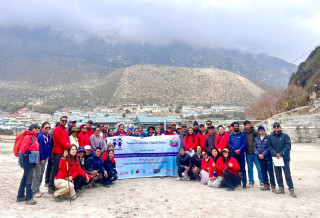
The Park People's Project, with its goal to establish local groups, create consumer committees, offer education on the development of opportunity zone community forests, advocate for forest protection, raise public awareness, generate income, and promote environmental tourism, played a pivotal role in Renu Saptari's journey. In the early stages, she was unanimously chosen as the secretary for the Jagatpur Village Development Committee group. This marked the initial stride in Renu's ongoing struggle to recognize and demonstrate that women are equally capable of meaningful work.
Renu Devi Shah embarked on a journey to village gatherings, passionately advocating for the preservation of forests and elucidating the advantages of forest protection. Her advocacy extended to championing the empowerment of women and fervently promoting the education of girls. During a challenging period marked by a 10-year conflict in the country, Renu persevered, steadfast in her commitment. The unwavering support and courage from her husband served as a constant source of motivation. Remaining dedicated to the cause, Renu became a stalwart member of the Park People Project, dedicating nearly a decade to the campaign aimed at safeguarding the Koshi Tappu Wildlife Sanctuary.
In a significant milestone on Baishakh 2062, Renu Devi Shah assumed the role of Chairperson at the Koshi Tappu Wildlife Sanctuary. Her impactful work served as an inspiration to others, leading to her appointment as the inaugural Chairperson of the Women's Intermediate Zone Management Committee in Nepal. This appointment was not only a recognition of her capabilities but also aimed to inspire women in Madhesh. However, Renu's journey was far from easy. She faced challenges such as threats from timber smugglers and poachers who, at times, went so far as to threaten her life. Despite these daunting obstacles, Renu continued to navigate her path with resilience and determination.
In reminiscing her journey, Renu Devi Shah shared a harrowing experience, stating, "Once, the leader of the then rebel Maoist contacted me and issued a threat, insisting that I cease my efforts to protect the forest. Despite the intimidation, I continued with my work as best as I could. However, the situation escalated when he planted a bomb at my home. Upon discovering this, I fled with my husband and children. Regrettably, when seeking refuge, the local community did not extend support due to fear that they too would be in jeopardy. It was disheartening to witness a lack of solidarity from those for whom I had tirelessly worked."
Despite facing such hardships and sorrows, there were moments when Renu Devi Shah contemplated abandoning everything and solely focusing on her household duties. However, her aspirations went beyond the confines of domestic affairs. Demonstrating unwavering determination in challenging circumstances, Renu served as the president of Koshi Tappu Wildlife Sanctuary from 2062 to 2070. During her tenure as president, she seized the opportunity to study and observe national forests, reserves, and community forests throughout the country. This experience propelled her to broaden the campaign's scope, emphasizing the crucial message that saving forests equates to saving lives.
In 2066, Renu Devi Shah became a founding member of the Asian People's Unity International Organization. In this role, she played a vital coordinating role, fostering connections among relevant stakeholders and comprehending events in various countries and abroad. Remarkably, during these two decades, Renu also pursued her academic studies, achieving post-graduation. Reflecting on her journey, she remarked, "I promoted education alongside my household responsibilities, community work, and the campaign for forest and environmental protection. By advancing my education to the post-graduate level, I considered it a powerful weapon to combat the darkness in life." Renu's commitment to multifaceted endeavors showcased her dedication to both personal and collective growth.
In 2065, a devastating flood hit Koshi, resulting in significant human and economic losses. Witnessing the profound impact of this disaster, particularly on the condition of women, Renu Devi Shah took action. In 2066, she founded a social organization called Women's Upliftment and Environment Forum Nepal. Through this initiative, she empowered the members of her community, both sisters and brothers, and initiated an environmental protection campaign. Recognizing her dedicated efforts, the government honored Renu with the Environmental Protection Women's Award in 2067. Further acknowledging her contributions, she received the Vibhushan Adhikarpatra in 2069. Internationally, Renu's commitment to environmental protection earned her the Abraham Conservation Award in 2070. In 2071, she was bestowed with the Gorkha Dakshin Bahu Vibhushan by the then President, a testament to the recognition of her exceptional service.
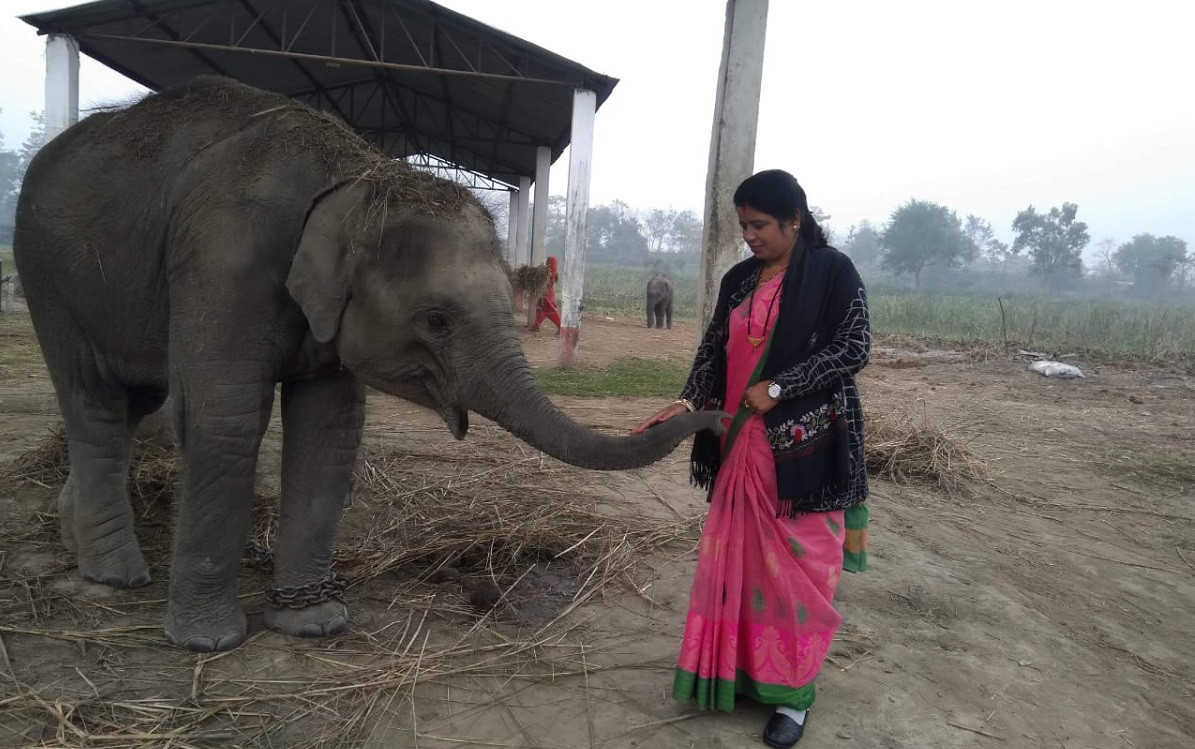
Devoting a significant portion of her time to forest conservation, Renu Devi Shah earned the endearing nickname from the locals as the 'Mother of Elephants.' Reflecting on this, she remarked, "As the forest holds a special place in my heart, I feel like Renu Devi Shah and the forest are synonymous. Through my efforts in protecting the forests, the elephant population has increased. While elephants occasionally venture into the villages, causing damage to farming, I have endeavored to conserve and nurture them. In return, the local people affectionately refer to me as the 'Elephant's Mother.'" Renu's deep connection with the environment and her efforts to protect it have earned her the heartfelt recognition of her community.
When asked about whether she gets angry, Renu Devi Shah responded with a smile, saying, "I enjoy it. I smile and move on." Her initiatives extended beyond forest conservation, encompassing efforts to safeguard forest products and wildlife. Renu also took the lead in arranging insurance for damages caused by wild animals entering villages. During the COVID-19 pandemic, upon receiving complaints about increased deforestation nationwide, she traveled across the country to assess the deforestation situation. As a member of the high-level investigation committee under the Prime Minister's Office, she not only investigated deforestation but also proposed measures to halt this environmental challenge. Renu's commitment to protecting the environment remained unwavering in the face of various challenges.
While the prime of her life was dedicated to forest protection, Renu Devi Shah has continued to make significant contributions across various sectors of society. In 2073, she served as a member of the Foreign Employment Promotion Board Nepal, advocating for the interests and concerns of foreign youths engaged in foreign employment. In 2074, Renu became a member of the assembly of Rajarshi Janak University, actively contributing to the advancement and increased access to education in the Madhesh province. Her multifaceted involvement showcases her ongoing commitment to the betterment of society in diverse domains.
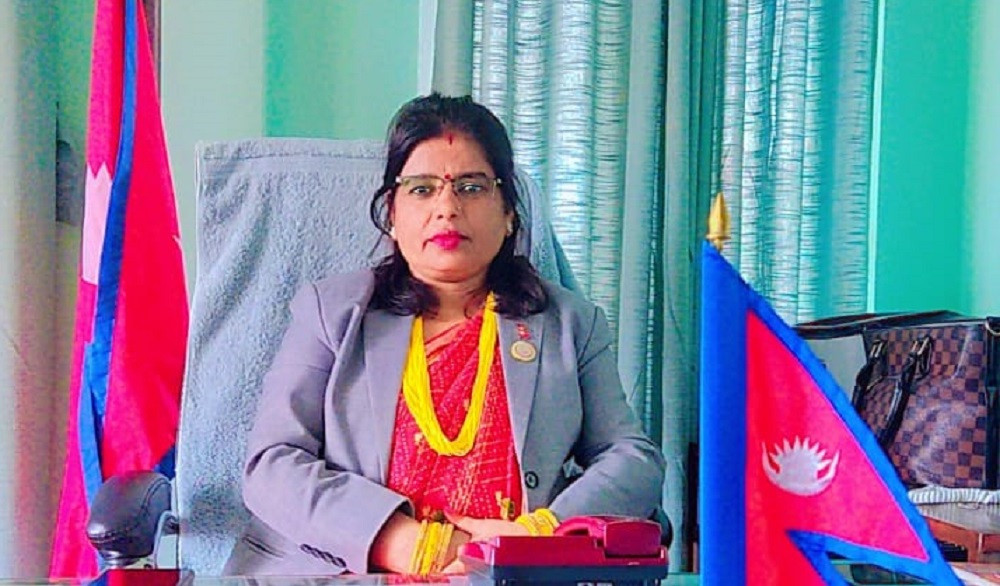
Currently serving as a member of the Madhesi Commission, Renu Devi Shah remains deeply engaged in her efforts to address environmental concerns. Despite her official role, she is haunted by news of deforestation and disturbed by the killing of wild animals, often losing sleep over these issues. In response, she actively engages with stakeholders, participating in discussions to curb logging and preserve the environment. Expressing her concerns, she said, "Neither our government has fully recognized that the sand, boats, and pebbles from our rivers are as valuable as gold, diamonds, and pearls, nor have they effectively conveyed this understanding to the local communities. It pains me greatly to witness the exploitation of such precious river resources, transported to India at the cost of a cow. Even now, a significant number of trucks continue to transport these materials. The long-term repercussions of this exploitation are severe." Renu's dedication to environmental protection remains resolute, advocating for sustainable practices and responsible management of natural resources.
Raising an alarm about the potential desertification of Madhesh if the exploitation of Churo (riverbed materials) is not halted, Renu Devi Shah emphasized, "While the world is increasingly concerned about climate change, our discussions sometimes overlook the plains. We haven't adequately acknowledged the fact that Madhesh is becoming depleted. We must take serious measures to prevent Madhesh from turning into a desert." Drawing attention to the environmental challenges specific to the plains, she underscores the urgent need for concerted efforts to protect the ecosystem in Madhesh.