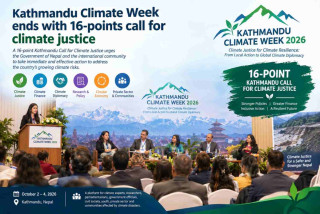
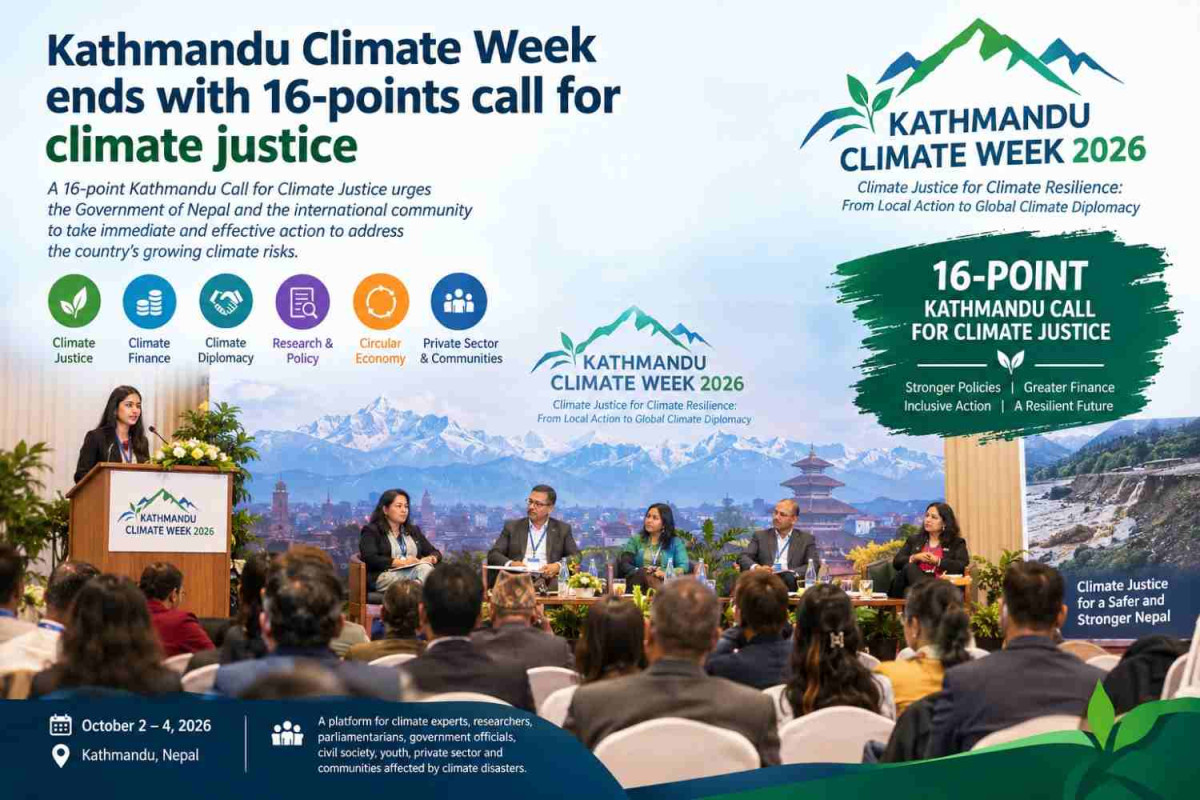
KATHMANDU, October 5: Kathmandu Climate Week 2026 concluded on Sunday with a 16-point Kathmandu Call for Climate Justice, urging the Government of Nepal and the international community to take immediate and effective action to address the country’s growing climate risks.
The three-day event, held from October 2 to 4, brought together climate experts, researchers, parliamentarians, government officials, civil society representatives, young people, private-sector leaders and communities affected by climate-related disasters.
The conference was held under the theme “Climate Justice for Climate Resilience: From Local Action to Global Climate Diplomacy.” Discussions focused on loss and damage, climate finance, climate diplomacy, research and policy, the circular economy and the role of the private sector in climate action.
The Kathmandu Call for Climate Justice was presented by Diksha Thapa Magar on behalf of the organising committee. The declaration calls for stronger climate policies, greater scientific research, predictable and grant-based climate finance, stronger climate diplomacy and meaningful participation of communities affected by climate change.
It also calls for a Climate Justice Act, a permanent parliamentary mechanism to address climate issues and stronger representation of Nepal in international climate negotiations.
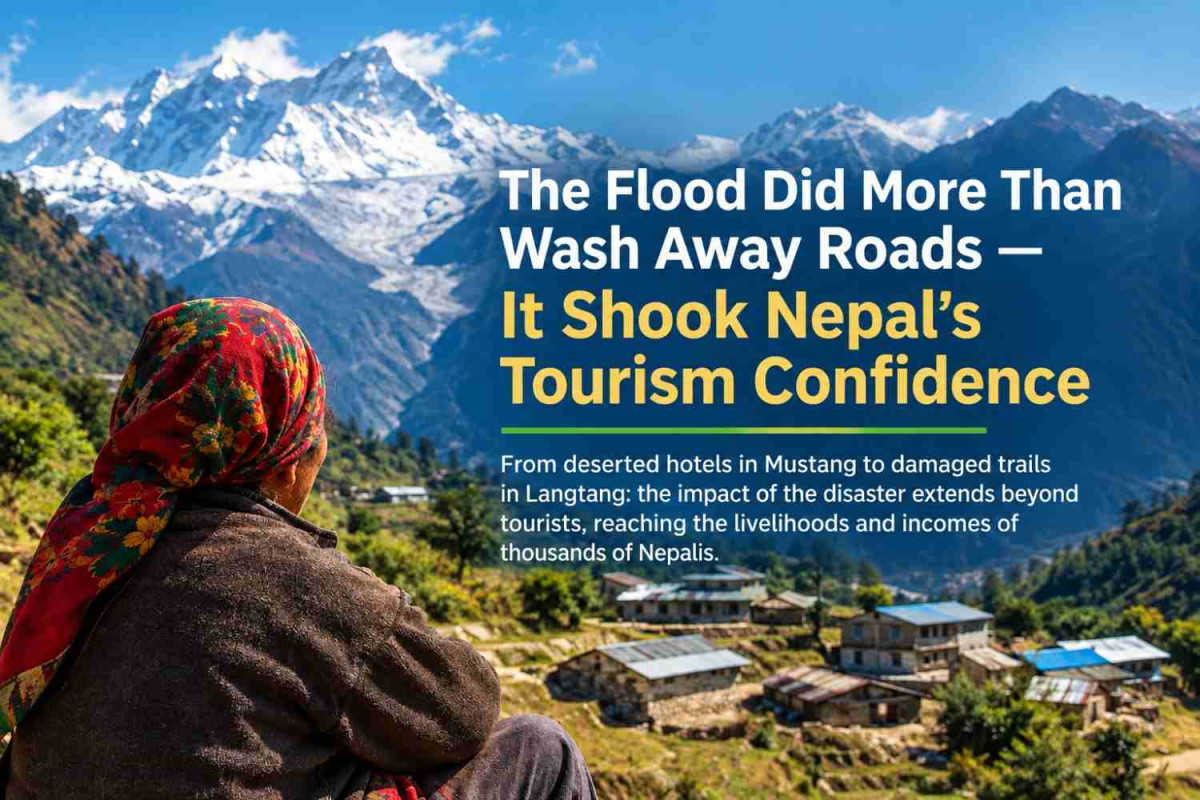
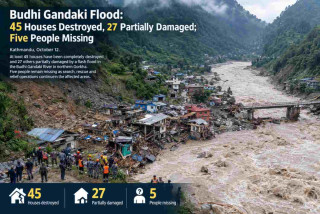
The impacts of the Rasuwa-Bhotekoshi disaster were also a major focus of the conference, with affected children and young people sharing their experiences and demands.
On the final day, discussions focused on climate justice, climate diplomacy and ways to strengthen Nepal’s voice in international climate negotiations. Secretary at the Ministry of Agriculture, Forests and Environment Dr Rajendra Prasad Mishra stressed the importance of cooperation among government, civil society, researchers and other stakeholders in strengthening Nepal’s climate response.
Organisers said future editions of Kathmandu Climate Week would expand their partnerships and discussions at the regional level. They said the long-term goal is to establish Kathmandu as a regional hub for climate advocacy and action.
The event was organised jointly by Creasion, Climate Risk and Resilience Lab, All In Foundation, Nepal Climate Centre, Nepal Peacebuilding Initiative, Institute for Rural Development, Wind Power Nepal, Nepal Bar Association and other partner organisations. A public screening of the film “Elephants in the Fog” is scheduled for October 5 as a continuation of the event.