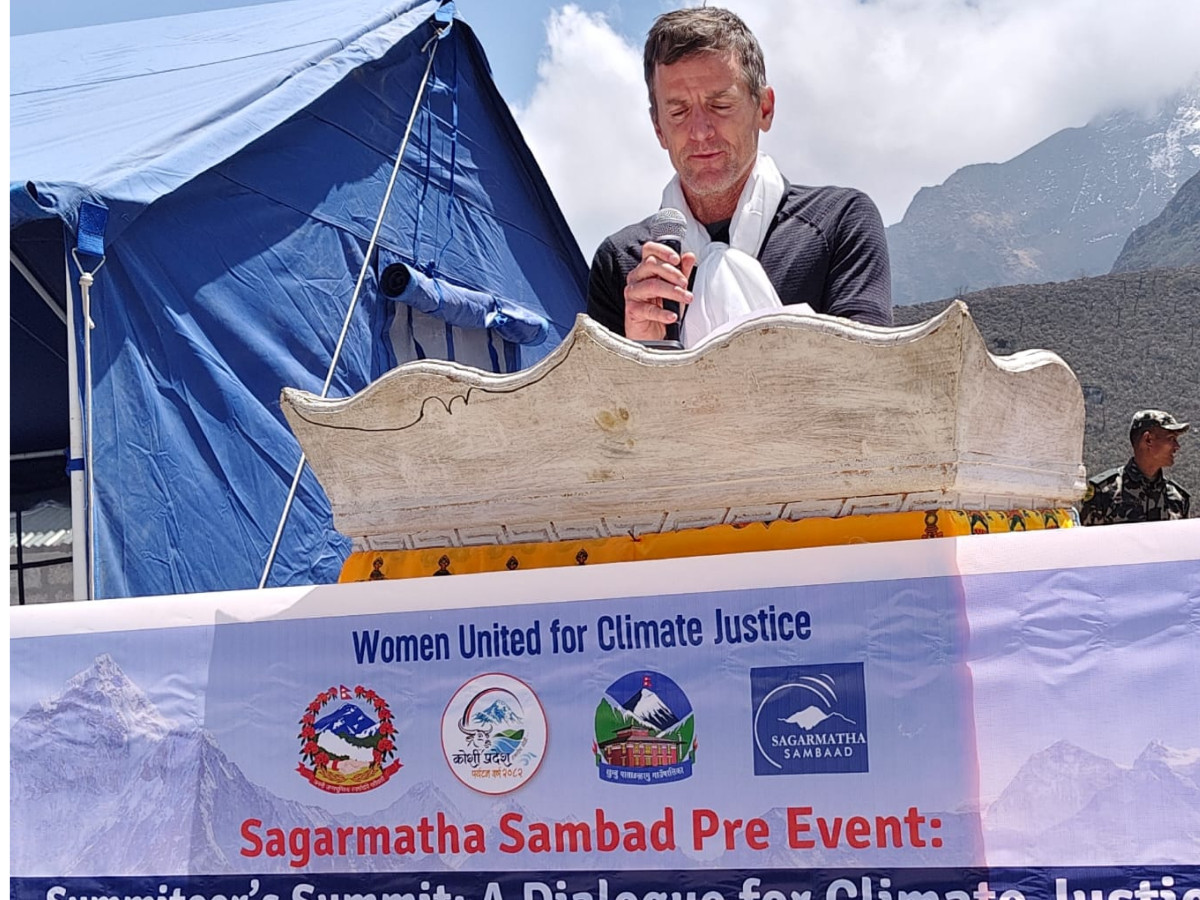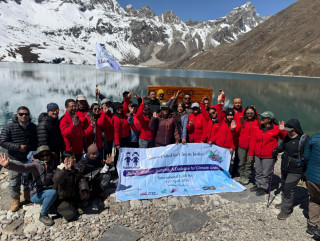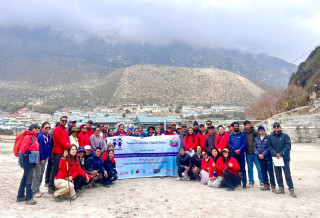
Kathmandu- "Sagarmatha Sambaad" is scheduled for May 16-18, and the management committee is working harder to raise awareness of it worldwide. The event, named after the revered Mount Everest, aimed to address pressing climate issues.
The first meeting of the management committee was held on Sunday, and it was decided to invite heads of state and government from coastal and mountainous countries, climate research experts, representatives from the national and international private sector, subject matter experts, and influential members of society.
According to Dr.Maheshwar Dhakal, the Ministry of Forests' focal person for the engagement, the committee has prepared the infrastructure and program outline for the discussion under the guidance of Foreign Minister Dr. Arju Rana Deuba.
The publicity and coordination committee will be headed by a secretary from the Ministry of Foreign Affairs, and the committee will consist of sixteen experts from various fields. It was also decided at the meeting to support partner organizations in showcasing best practices for mitigating the effects of climate change, not just about reducing emissions, but also by ensuring that vulnerable communities have a voice in decision-making processes.
Preliminary talks centered on children and youth will be held, along with dialogues at the provincial level, Secretary Dhakal said. The secretariat for the dialogue will be established, and the necessary personnel from the Ministry of Foreign Affairs, the Ministry of Forests, the Office of the Prime Minister, and the Council of Ministers will be assigned.
The committee, chaired by the Foreign Minister, includes the Minister of Forests and Environment, Ain Bahadur Shahi Thakuri, as co-chair. Members include the Chief Secretary of the government, secretaries from the Prime Minister's Office, Ministry of Foreign Affairs, Ministry of Finance, Ministry of Home Affairs, National Planning Commission, Ministry of Culture, Tourism and Civil Aviation, Ministry of Energy, Water Resources and Irrigation, the Executive Director of the Alternative Energy Promotion Center, and the Member Secretary of the National Nature Conservation Fund. The Member Secretary of the committee is the Secretary of the Ministry of Forests.
Previously, a preparatory meeting was held on January 11, attended by Prime Minister KP Sharma Oli. This meeting discussed inviting heads of state or government from neighboring countries such as India, China, and South Asian nations as special guests for the dialogue. On January 22, Prime Minister Oli announced that the dialogue would take place in Kathmandu in conjunction with the International Year of Glaciers, 2025.
The Sagarmatha Dialogue, which was initiated by the then Prime Minister Oli in 2019, was postponed at the last minute due to COVID-19.
Dialogue for Climate Justice
The government is organizing this dialogue to gain global leadership on climate change issues and advocate for climate justice, as stated by Deepak Kumar Kharal, Secretary of the Ministry of Forests and Environment. The government has agreed to have this discussion in every two years.
The dialogue will also advocate to support for restitution incurred by climate change that Nepal should receive, as well as payment for the environmental services provided by Nepal, while drawing international attention to the situation where Nepal is at high risk despite low carbon emissions. Without these measures, the risk of exacerbating existing inequalities remains high.
According to the Paris Agreement, the global community has agreed to limit the increase in the Earth's temperature to no more than 1.5 degrees Celsius by the end of this century. However, it is estimated that the average temperature in the Himalayan region will exceed 1.8 degrees Celsius before 2050. Various studies suggest that due to rising temperatures, two-thirds of the glaciers in this region are expected to melt.
Secretary Kharal emphasizes that the dialogue will contribute to the development and expansion of climate science and technology, amplify the agenda of mountainous countries, and foster collaboration with mountain nations.
Dadhiram Bhandari, the Secretary responsible for the groundwork for the dialogue from the Ministry of Foreign Affairs, stated that the Nepalese government is prioritizing the implementation of this program.
The main objective of the dialogue is to highlight the impacts of climate hazards like GLOFs and permacrisis on mountainous regions, with the hope that it will create a unified understanding among the citizens of mountainous areas and the international community.
Source: Bhisma Raj Ojha/ Ra. Sa. Sa.
By Aastika Bhujel