
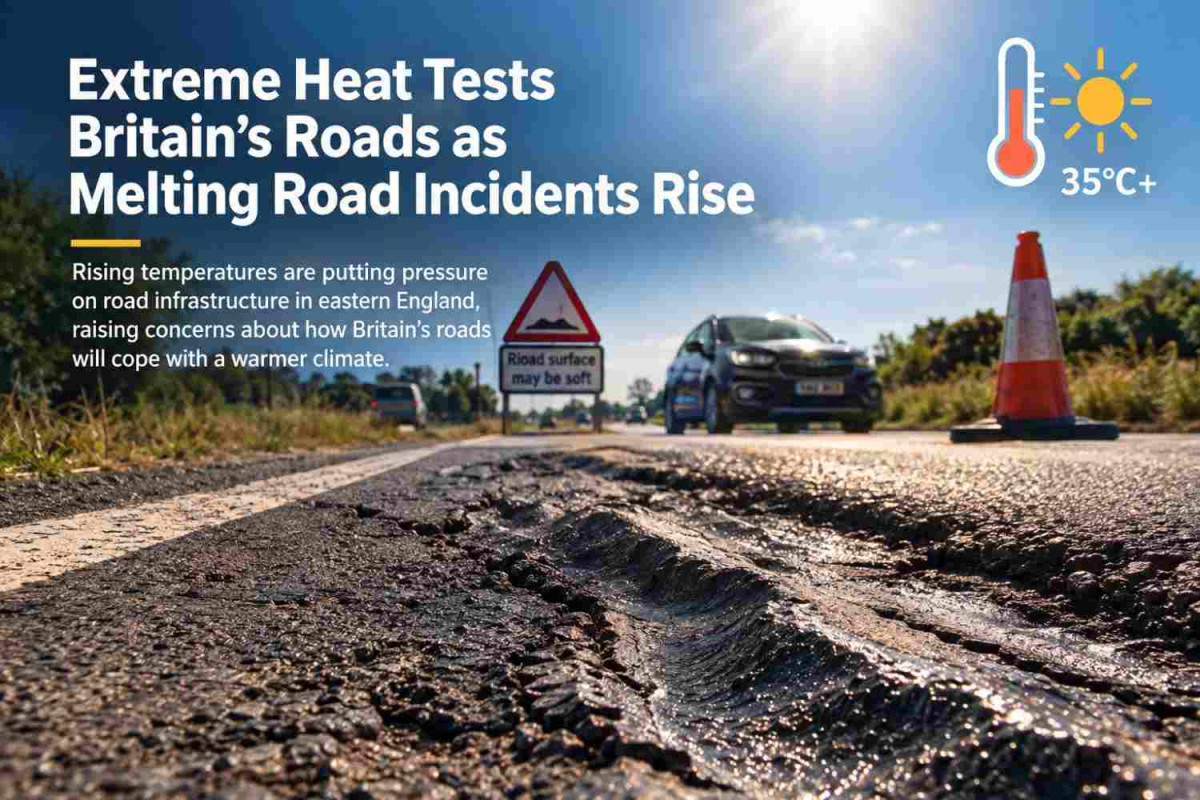
Kathmandu, September 28 — Extreme heat is putting growing pressure on Britain’s road network, with the number of reported cases of road surfaces softening or “melting” in eastern England rising sharply in recent years.
Data obtained by the BBC from highway authorities in the East of England shows that comparable reports of heat-related road damage increased from 33 cases in the 2023–24 financial year to 55 in 2025–26, an increase of about 67 percent.
The incidents have occurred as the United Kingdom experiences increasingly frequent periods of unusually high temperatures.
The problem is not that roads literally turn into liquid. Instead, high temperatures can soften the bitumen used to bind asphalt, making road surfaces more vulnerable to deformation under traffic.
Experts say the issue highlights a growing challenge for infrastructure designed largely around historical weather conditions.
Roads can become much hotter than the air
When temperatures rise, dark asphalt absorbs solar radiation and can become considerably hotter than the surrounding air.
The Chartered Institution of Highways and Transportation says that when air temperatures reach around 30°C, road surfaces can reach approximately 40°C to 50°C, while some road surfaces begin to soften above 50°C.
Heavy traffic can increase the damage. Vehicles repeatedly applying weight to softened asphalt can contribute to rutting, deformation and other surface failures.
Dr Mashael Kamran, a post-doctoral research associate at the University of Cambridge who studies transport infrastructure, said many UK roads were designed for cooler conditions.
She said road surfaces could become significantly hotter than air temperatures and that heavy-duty traffic could further contribute to deformation.
Suffolk and Norfolk among areas reporting incidents
The data collected by the BBC shows that the problem varies considerably between local authorities.
In Suffolk, reported cases of roads affected by heat increased from three to eight over the comparable period.
Norfolk recorded a rise in the number of “dustings”, a measure in which highway workers spread small amounts of sand or stone over vulnerable road surfaces to reduce the effects of softened asphalt. The number increased from 29 to 46.
Suffolk County Council also reported additional incidents during the summer.
The authority said that while heat-related road problems remained relatively uncommon, it had experienced several cases following periods of exceptionally high and prolonged temperatures.
Suffolk Highways has used granite dust during periods of extreme heat and said it was working with other highway authorities, suppliers and industry partners to investigate road treatments and materials that could perform better across a wider range of temperatures.
A road in Suffolk was closed after asphalt problems
Earlier this year, part of the A143 at Stanton near Bury St Edmunds in Suffolk was closed as an emergency measure after reports that sections of asphalt were being lifted by vehicles using the road.
The road surface had reportedly experienced heat-related problems previously.
Such incidents can become a safety issue because softened surfaces may deform under traffic, creating uneven sections and increasing the risk to drivers.
Britain is getting warmer
The road problems are occurring against a backdrop of rising temperatures in the UK.
The Met Office reported that 2025 was the UK's warmest year on record, with an annual mean temperature of 10.09°C. It also found that summer 2025 was the warmest summer recorded in the UK.
In 2026, the country experienced another series of exceptional heat events, with temperatures reaching 35°C or higher in May, June and July — the first year in the UK's national weather record when that threshold was reached in all three months.
The increasing frequency of extreme heat is creating new challenges for infrastructure that was designed using historical climate conditions.
Climate change creates wider risks for transport
The UK Department for Transport has acknowledged that climate change is already affecting transport infrastructure.
Its climate adaptation strategy identifies heatwaves, flooding and storms among the climate hazards capable of damaging transport assets and disrupting services.
The department says it is working with highway authorities to improve the resilience of road networks through guidance, tools and resources.
National Highways has also identified climate change as a long-term challenge for the strategic road network and is examining how road materials and maintenance practices can be adapted to future conditions.
Engineers call for better road materials
Experts say adapting roads to higher temperatures could require changes in both construction materials and maintenance practices.
Possible measures include using asphalt mixtures and binders capable of tolerating higher temperatures, improving road design and carrying out preventative maintenance before extreme weather causes serious damage.
The Asphalt Industry Alliance says asphalt must withstand a wide range of temperatures throughout the year and that extreme heat can affect the performance of road surfaces.
The Institution of Civil Engineers has also warned that extreme heat can cause roads to soften and deform, particularly when high temperatures coincide with heavy traffic.
Reactive repairs may not be enough
Another concern is the way roads are maintained.
Experts say limited local-government budgets can encourage authorities to rely on surface treatments and patch repairs rather than more extensive road renewal.
While such measures can address immediate problems, they may leave underlying weaknesses in road surfaces.
The UK government has therefore placed increasing emphasis on long-term climate adaptation and improving the resilience of transport infrastructure.
The challenge is bigger than ‘melting roads’
The rise in reported heat-related road incidents does not mean that Britain's entire road network is at immediate risk of melting.
The incidents remain relatively uncommon, and the available data also varies between local authorities. Differences in reporting systems, road materials, traffic levels and local temperatures mean the figures should not be interpreted as a uniform national trend.
However, engineers and climate experts say the incidents provide a visible example of a wider problem: infrastructure must increasingly cope with weather conditions outside the range for which much of it was originally designed.
Extreme heat can damage road surfaces, disrupt transport services and increase maintenance costs. Other climate hazards, including intense rainfall and flooding, create additional pressures on the same infrastructure.
As Britain experiences warmer temperatures and more frequent extreme-weather events, the question for highway authorities is no longer simply how to repair roads after damage occurs.
It is how to design, maintain and finance roads that can remain functional in a changing climate.