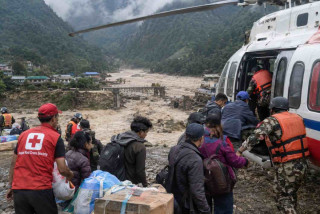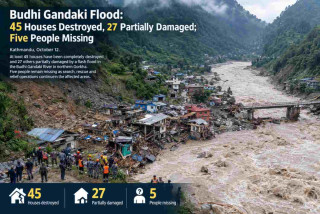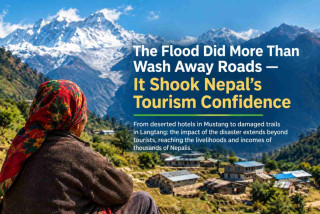
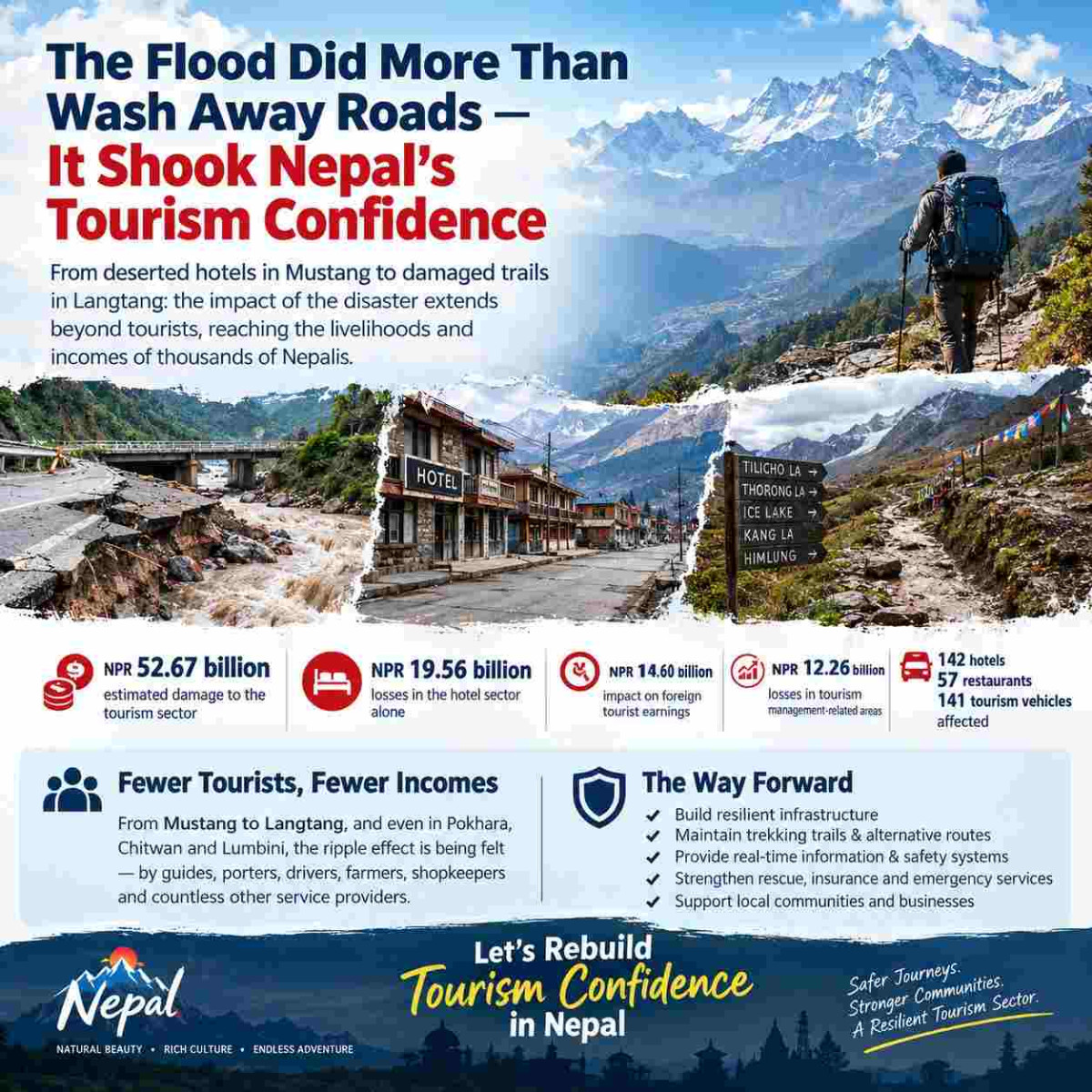
The devastating floods in the Bhotekoshi and Trishuli rivers have dealt a major blow to Nepal’s tourism sector. The floods have directly damaged roads, bridges, hotels, restaurants, trekking trails and other tourism infrastructure, while also affecting the jobs and incomes of thousands of people whose livelihoods depend on tourism. With major routes used by tourists disrupted, reaching popular destinations has become difficult, leaving hotel and tourism businesses in some areas waiting for visitors who are no longer arriving as expected.
According to preliminary estimates, floods and landslides have caused more than NPR 52.67 billion in damage to the tourism sector. The hotel sector alone is estimated to have suffered losses of around NPR 19.56 billion. Preliminary assessments also estimate an impact of around NPR 14.60 billion in foreign tourist earnings and approximately NPR 12.26 billion in tourism management-related losses. The floods have affected 142 hotels, 57 restaurants and 141 tourism-related vehicles.
Fewer Tourists, Quiet Businesses in Mustang
Mustang is one of Nepal’s major tourist destinations. However, natural disasters have increasingly begun to affect tourism businesses in the region. Road disruptions and adverse weather conditions have reduced tourist movement. As hotels and restaurants experience fewer visitors, tourism entrepreneurs are facing growing economic pressure.
In Mustang, 61,263 tourists visited during the month of Shrawan, while the number dropped to 31,989 in Bhadra. This represents a 47.78 percent decline in tourist arrivals during the period. The number of domestic tourists fell by 46.16 percent, while visitors from SAARC countries declined by 52.05 percent, according to the available figures.
The decline in tourist numbers affects more than hotels and restaurants. When tourist movement falls, the incomes of guides, porters, drivers, local producers, farmers, shopkeepers and other service providers are also directly affected. When tourism spending fails to reach local markets, the impact spreads throughout the wider local economy.
Risks from Roads to Trails in Manang
Manang has also been affected by floods and landslides. Rising water levels in the Marsyangdi River have increased risks to settlements and infrastructure in surrounding areas. According to reports, around 65 households in Talgaon have been exposed to flood risks. Damage to roads and bridges has disrupted transportation and increased risks for local communities.
The disruption of the Besisahar–Manang road has created difficulties for both tourists and local residents. Trekking routes toward Tilicho, Thorong La, Ice Lake, Kang La and Himlung have also faced increased risks. If roads and trekking trails are not repaired in time, tourist travel could be further affected during the upcoming tourism season.
Damage to Langtang’s Trekking Routes
Tourism in the Langtang region has also been affected by floods and landslides. Damage to roads and bridges between Langtang and Dhunche has disrupted transportation. Areas around Syabrubesi have also experienced the impacts of floods and landslides.
Disruptions to tourist movement have affected hotels, restaurants, guides, porters and families whose livelihoods depend on tourism in the region.
Even a temporary disruption to a trekking route can have a significant impact on tourism businesses. When tourists cannot travel safely, they may change their destination or postpone their trip altogether. Regular inspection of trekking trails, immediate repairs and alternative routes in high-risk areas are therefore essential for tourism safety.
Indirect Impacts on Pokhara, Chitwan and Lumbini
Major tourist destinations such as Pokhara, Chitwan and Lumbini, which may not have experienced direct physical damage from the floods, are also facing indirect impacts. Road disruptions, unfavorable weather conditions and negative disaster-related news can affect tourists’ travel plans, increasing uncertainty for hotels, restaurants, travel agencies and other tourism businesses.
In August 2026, Nepal received 85,444 international tourist arrivals, a 3.6 percent decline compared with the same month the previous year. Travel advisories and safety alerts issued by some countries regarding travel to Nepal may also influence tourists’ decisions.
Challenges During the Main Tourism Season
The period from September to November is considered particularly important for Nepal’s tourism industry. A large number of international and domestic tourists visit different destinations during these months. Around 40 percent of Nepal’s annual tourist arrivals are reported to occur during this period.
As a result, damage to roads, trekking trails, bridges and other infrastructure at the beginning of the main tourism season could have further consequences for tourism businesses if repairs and reconstruction are not completed in time.
For tourism businesses, the challenge is not simply to bring tourists back. It is also to ensure that they can travel safely. Tourists need easy access to reliable information about road conditions, weather, trekking risks, rescue arrangements, health services and other safety measures.
A Stronger Focus on Safe Tourism
It may not be possible to completely prevent tourism-related risks caused by natural disasters. However, risks can be reduced through preparedness, resilient infrastructure, effective information systems and rapid rescue mechanisms.
Roads and bridges need to be designed and constructed with flood and landslide risks in mind. Trekking trails require regular maintenance, while alternative routes should be prepared in areas exposed to high risks.
There is also a need to develop effective insurance, rescue and emergency communication systems for tourists and tourism businesses. Providing real-time information on weather and road conditions can help tourists plan their journeys more safely. This can reduce uncertainty during disasters and help maintain confidence in Nepal as a tourism destination.
Rebuilding Tourism Confidence
Floods have damaged more than roads, bridges and trekking trails; they have also affected the incomes and sense of economic security of communities that depend on tourism. When one tourist does not arrive, it is not only a hotel room that remains empty. The driver, guide, porter, farmer, shopkeeper and other service providers connected to that tourist may also lose income.
Therefore, when assessing the damage to the tourism sector, the impact on local economies must be considered alongside physical infrastructure losses.
The priority now should be not only to rebuild damaged infrastructure but also to make Nepal’s tourism sector more resilient to disasters. Strengthening roads and bridges, repairing trekking trails, developing alternative routes, improving weather and risk-information systems, and strengthening rescue and insurance mechanisms should be treated as important priorities.
At the same time, tourists need regular and credible information about the safety conditions of Nepal’s destinations. Clear communication can help prevent uncertainty and enable visitors to make informed travel decisions.
Nepal’s tourism is built around its natural beauty, culture, mountains and adventure. Therefore, simply returning tourism to normal after a disaster is not enough. Long-term planning is needed to reduce the damage future disasters could cause to the sector.
Resilient infrastructure, reliable information, effective emergency response systems and meaningful participation of local communities can help make Nepal’s tourism sector more resilient.
Roads washed away by floods can be rebuilt. Bridges can be reconstructed, and damaged hotels and trekking trails can be repaired. But once tourists lose confidence in a destination, rebuilding that trust can take much longer. The challenge, therefore, is not only to rebuild physical infrastructure after the floods, but also to rebuild confidence in Nepal’s tourism sector.