
United Nations (UN) Secretary-General Antonio Guterres is currently on a four-day visit to Nepal. On Sunday, at 1 am, he was welcomed by Foreign Minister NP Saud at Tribhuvan International Airport.
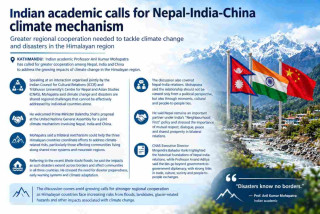
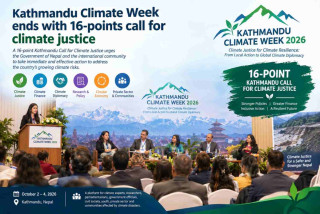
His visit to Nepal is primarily centered on the subject of climate change and the challenges faced by the Himalayan region, in line with the goals of sustainable development.
During the visit, he engaged in meetings with various high-ranking officials, including Foreign Minister NP Saud, Deputy Prime Minister Purna Bahadur Khadka, Prime Minister Pushpa Kamal Dahal Prachanda, President Ram Chandra Paudel, and former Prime Ministers Sher Bahadur Deuba, KP Sharma Oli, Madhav Kumar Nepal, Baburam Bhattarai, Jhalnath Khanal, and others.
Reports indicate that the discussions during these meetings primarily revolved around the topic of climate change and its impact on Nepal. Secretary-General Guterres is scheduled to visit Syangboche in Solukhumbu to gain firsthand insights into the effects of climate change.
Nepal, through Secretary-General Guterres, aims to communicate to the world the significant repercussions of climate change on countries like Nepal. Nepal is home to the world's highest peak, Mount Everest, and in recent times, the melting of snow in the Himalayan region has been escalating due to climate change, significantly affecting the environment.
As the COP-28 event approaches, set to take place in the UAE in the last week of November, Secretary-General Guterres intends to convey a powerful message about the consequences of climate change by visiting Syangboche and the Annapurna circuits in Solukhumbu.
Prime Minister Dahal, who arrived to participate in the General Assembly, also delivered a speech at the 'Climate Ambition Summit' held at the UN headquarters. In this capacity, Prime Minister Prachanda, serving as the president of the least developed countries (LDC) and as the Prime Minister of Nepal, affirmed Nepal's national commitment to achieve 'net-zero' carbon emissions by 2045.
He emphasized Nepal's dedication to adhere to the Paris Agreement, whose primary objective is to restrict global warming to 1.5°C, necessitating the reduction of carbon emissions by member nations. Prime Minister Prachanda, who also chairs the LDC, highlighted that LDC countries are bearing the brunt of climate change and advocated for a five-fold approach to tackle climate change challenges.