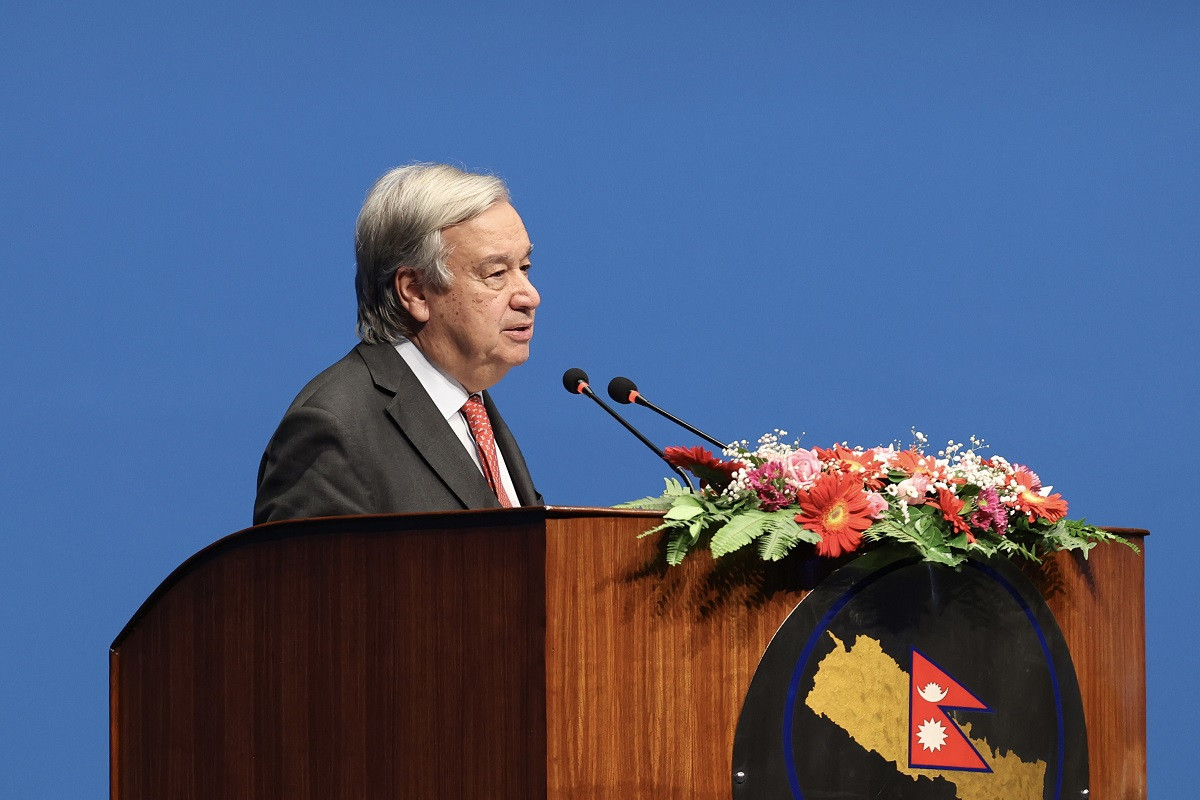
United Nations Secretary-General Antonio Guterres highlights the imperative for enhanced international cooperation to expedite climate action during his address to the joint session of Nepal's Federal Parliament.
Guterres stressed the necessity for substantial global collaboration to bolster the development of Nepal and other developing nations, allowing them to accelerate climate action and confront the prevailing worldwide crisis. Nepal, he acknowledged, stands at the forefront of climate action, commending the nation's commendable progress towards achieving zero carbon emissions by 2045, driven by its substantial forest cover, which encompasses approximately half of its territory.
He lauded Nepal as a pioneer in advancing early warning systems designed to safeguard the lives of every global citizen by 2027, acknowledging the ongoing challenges faced by Nepal, a developing nation, as it grapples with the enduring impact of global crises.
While Nepal's carbon emissions contribute only minimally to global totals, Guterres acknowledged the severe repercussions experienced by the country. Notably, he cited the rising intensity and severity of monsoons, storms, and landslides, along with the alarming rate at which glaciers in the region are melting. In the past 30 years, Nepal has lost nearly one-third of its glaciers, underscoring the stark realities of climate change.
Secretary-General Guterres made it clear that the devastating consequences of climate change are apparent, with instances of overflowing lakes, escalating river and sea levels, and increasingly vulnerable mountainous regions prone to rockslides, landslides, and avalanches. Of particular concern was the shrinking of Himalayan rivers, which provide essential clean water to over a billion people. He warned that the future might see limited flows in major Himalayan rivers like the Indus, Ganga, and Brahmaputra, resulting in heightened competition for essential water and land resources.
Guterres expressed deep concern for the communities in Nepal enduring the harsh impacts of the climate crisis, labeling the situation as an unjust and devastating injustice. He reassured Nepal of the unwavering support of the United Nations.
The Secretary-General called for the allocation of at least five trillion dollars annually in affordable, long-term financing for the Sustainable Development Goals and climate action. He highlighted that Member States had welcomed this resolution during the recent General Assembly session and urged them to take concrete steps to translate their commitments into reality. Furthermore, he implored developed nations to honor their promise of one billion dollars annually and advocated for the mobilization of the Loss and Damage Fund during this year's COP 28 (Climate Change Conference), a fund that the Nepali people depend on for their well-being.