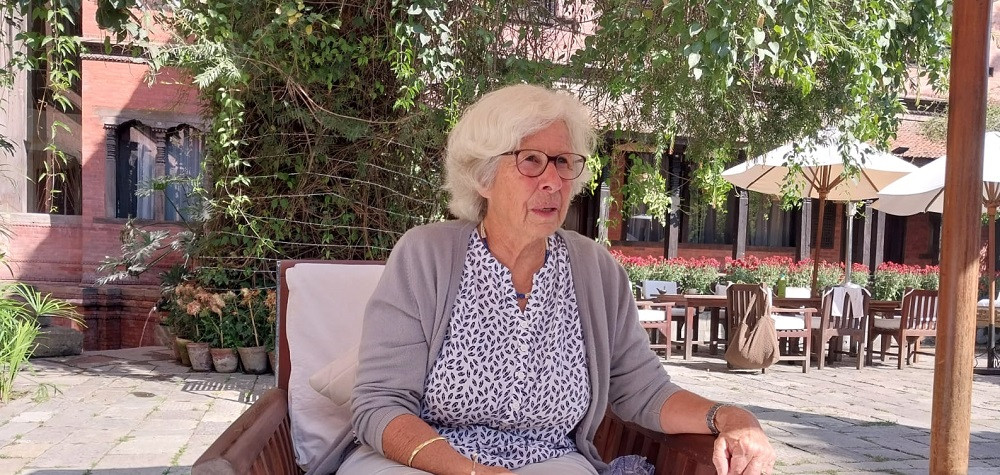
Dr. Katrin Hagen, a 74-year-old Swiss national, first visited Nepal in 1952. Her father, Toni Hagen, renowned for introducing Nepal to the world. As the first foreign tourist in 1950, he extensively explored Nepal, documenting its geological, cultural, and natural richness. In keeping with her father's legacy, Katrin expresses, 'I continue visiting Nepal to honor my father's affection for this land.' Katrin relishes trekking across Nepal and advocating for a cleaner environment, stressing the significance of community involvement in shaping a sustainable future. Sathsathai talked to Dr. Katrin Hagen about her experiences and observation about Nepal:
What do you recall your first visit to Nepal?
When I first came to Nepal, I was very small and it was 1953 so I remember very few things. What I remember is because I have seen the photos and I was told many things by my father. Kathmandu at that time was totally different. There was no road connection with India, there was a flight three times a week. Soon the airport was built in Pokhara and sometimes we used to go there. At that time, in Pokhara, there were no hotels, nothing, only the old villages.
Could you please share about the changes you have observed from 1960s to 2023 in terms of environmental shifts?
My father loved the Himalayas. He used to tell us that he had promised himself once he became a geologist that he would go to the Himalayas and study there. And, that is what he did and we came to Nepal. When reflecting on my experiences in Nepal's Himalayas from the 1960s to 2023, notable changes in the environmental landscape become evident, putting Nepal's Himalayas at risk. During my visit to Rowlwaling in the 1960s, I distinctly recall witnessing the presence of advancing glaciers amidst abundant snow in the Himalayan region. However, in recent times, there's been a noticeable scarcity of snow due to the escalating global temperatures.
One noteworthy transformation lies in the forest cover. Comparing the situation from 1975 to the present, there's been a marked increase in forested areas. Initially governed by the government, forest management has since been entrusted to local communities, leading to enhanced preservation efforts. A comparison of photographs from the 1950s depicting places like Shivapuri with their current state reveals a substantial expansion in forest coverage.
What challenges do you encounter when traveling to mountain regions?
When travelling through mountainous regions, several challenges come to the forefront. During my recent trip from Dailekh to Jumla by car, I noticed the presence of well-built roads. However, an issue arises in their utilization. While these roads should ideally facilitate the transportation of local produce like apples and oranges downhill, the reality is quite different. Instead, Indian and Chinese apples transport to those area, leading to an influx of unhealthy products in the local market, posing risks to both health and the environment.

A pertinent concern highlighted by my father is the need for fair pricing for farmers' produce. Without adequate price of their product, farmers might seek opportunities abroad, often migrating to Arab nations. This trend has resulted in a significant demographic shift, with most men employed in Arab countries while women manage farming in the countryside. When illness strikes, they are compelled to sell their produce to afford medical care, thereby posing a formidable challenge to the community.
What is your observation on Nepal's social inclusion policy?
Nepal has made significant legal provisions aimed at social inclusion and women's empowerment, notably visible in certain urban areas. However, the full implementation of these policies remains a challenge, particularly in remote regions. Consequently, the conditions for women in these areas mirror those of the past, showcasing an apparent gap between policy intent and on-ground realities.
What is your observations concerning the level of awarness among local people on environemental conservation and climate change issues?
I visted Ropla while operating a health camp, I noticed a lack of awareness among the locals regarding climate change and related environmental concerns. Their focus primarily revolves around traditional farming practices without much consideration for broader environmental impacts. The use of chemical fertilizers without awareness of modern farming techniques is prevalent.
When natural disasters like landslides occur and affect their land, their perspective is limited to the immediate event without understanding the underlying causes related to climate change. The erratic weather patterns, alternating between heavy rains and dry periods, lead to destructive outcomes, yet there's a lack of awareness linking these occurrences to climate change. Despite having access to sufficient water, its availability at the right time remains scarce.
What suggestions do you propose to address these challenges? What actions should Nepal take regarding climate change?
Firstly, it's crucial to raise awareness among the local population about the correlation between natural disasters like floods, landslides, erosion, and climate change. While Nepal's contribution to global emissions is minimal, it's essential to highlight the role of larger carbon-emitting nations in driving climate change.
Secondly, Nepal possesses immense potential for clean and sustainable energy sources such as hydroelectricity, solar, and wind power. By reducing reliance on fossil fuels, especially those imported from India, Nepal can not only benefit the environment but also achieve energy independence.
Recognizing the diverse impact of climate change across sectors like development, agriculture, and marginalized communities, Nepal should prioritize minimizing its effects. This involves adopting a development model centered on land and road preservation, ensuring river cleanliness, reducing plastic, decreasing reliance on fossil fuels, and preparing for climatic disasters.
While Nepal cannot single-handedly reverse climate change, proactive efforts to mitigate its impact and adapt to the evolving climate are pivotal for fostering a more sustainable future.
Does the Tony Hegan Foundation plan to address climate change issues directly?
The Tony Hegan Foundation's current focus primarily centers on heritage site preservation rather than direct involvement in climate change initiatives. Our efforts entail collecting historical photographs to create exhibitions, showcasing Nepal's past to provide insight into its earlier state. We encourage people to contribute photos, particularly those depicting places like Rowlwaling glaciers, Langtang, and other Himalayan regions. While this initiative doesn't directly tackle climate change, it serves a crucial purpose in educating people about the changing landscape of Nepal's Himalayas, glaciers, and mountains, fostering a better understanding of the impacts brought about by climate change.