Kathmandu: Kathmandu University's aspiration to produce hydrogen domestically and power vehicles with it became a reality on Sunday. After two years of research and experimentation into green hydrogen production and utilization, the university successfully produced hydrogen.
Dr. Biraj Singh Thapa, Chief of KU's Green Hydrogen Lab and Associate Professor, expressed, "We aimed to produce hydrogen locally and employ it in vehicles. Today, we have accomplished that goal."
Sharing his joy on Facebook, he stated, "History is made once, but forever. Just now, the Green Hydrogen Production and Refueling Station at Kathmandu University has successfully completed testing and begun refueling the hydrogen car. Today marks a milestone for hydrogen in the country."
He mentioned that the Nepal Oil Corporation had financially supported hydrogen production and its utilization in vehicles.
Two years ago, the Nepal Oil Corporation (NOC) and KU forged an agreement regarding hydrogen usage in Nepal as an alternative fuel, along with hydrogen-related policies and operational methods to demonstrate the feasibility of operating vehicles with hydrogen on Nepali roads.
Read this also : Hydrogen Car Introduced in Nepal : A Milestone in the Transition from Fossil Fuels
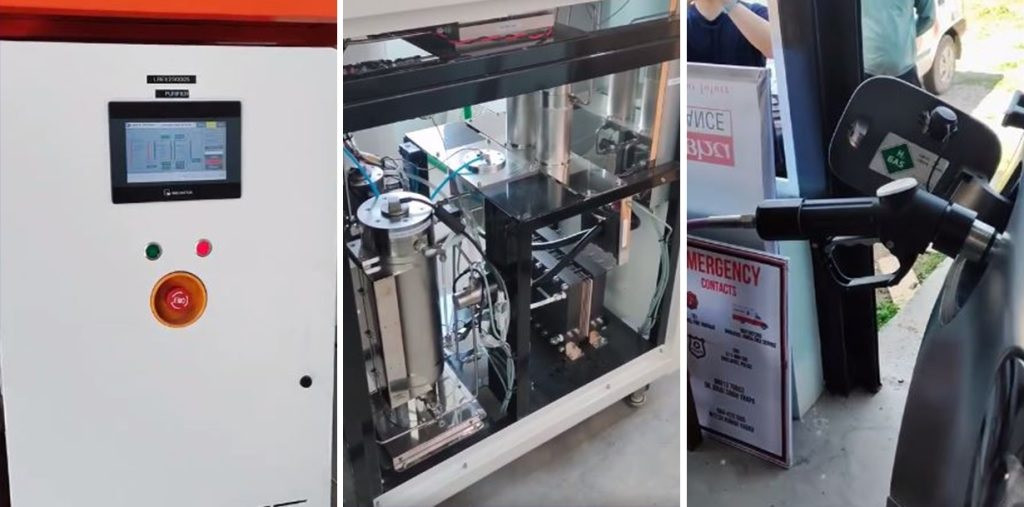
Dr. Thapa revealed that a Hyundai Nexo car was imported from Korea with support from the NOC five months ago. Additionally, a Hydrogen Refueling Centre was established at the university with backing from a Korean Hydrogen Production Company, with the NOC providing Rs. 50 million to the university.
"Starting from Sunday, efforts have begun to fill hydrogen in Nexo cars imported from Korea with technical support from a Korean Hydrogen Production Company," said Dr. Thapa. "After providing water and electricity to the hydrogen refueling center, hydrogen production will commence from processed water, followed by drying and purifying the produced hydrogen, storing it in low-pressure tanks, and filling the car from the low-pressure tank through a high-pressure tank."
He noted that although hydrogen production began for experimental purposes at KU, it marks Nepal's first attempt at utilizing hydrogen for transportation. The Hydrogen Refueling Centre established on KU's premises is expected to produce two kilograms of hydrogen daily for research and testing. Global data shows that it costs around USD 5 to produce one kilogram of hydrogen worldwide.
According to Dr. Thapa, it will require 10 liters of water and 40 to 45 units of electricity to produce one kilogram of hydrogen from the established hydrogen production facility at KU. He mentioned that with five kilograms of hydrogen filled in Nexo cars within KU, they can travel up to 650 kilometers.
A budget of USD 33,000 has been allocated from the support fund provided to KU for the establishment of the refueling center, amounting to around Rs. 13 million.
Preparations are underway at KU to inaugurate the hydrogen car parked within the university by Prime Minister Pushpa Kamal Dahal 'Prachanda' and to organize exhibitions of hydrogen cars at various locations in Nepal.
KU aims to initiate a pilot project for establishing hydrogen refueling centers, facilitating the refueling of 30 to 35 hydrogen vehicles, and advancing policies and procedures related to hydrogen in Nepal.
Currently, there are no established policies or procedures regarding hydrogen in Nepal, such as its use as fuel, issuance of number plates for hydrogen vehicles, issuance of bluebooks, or licensing for establishing refueling centers.