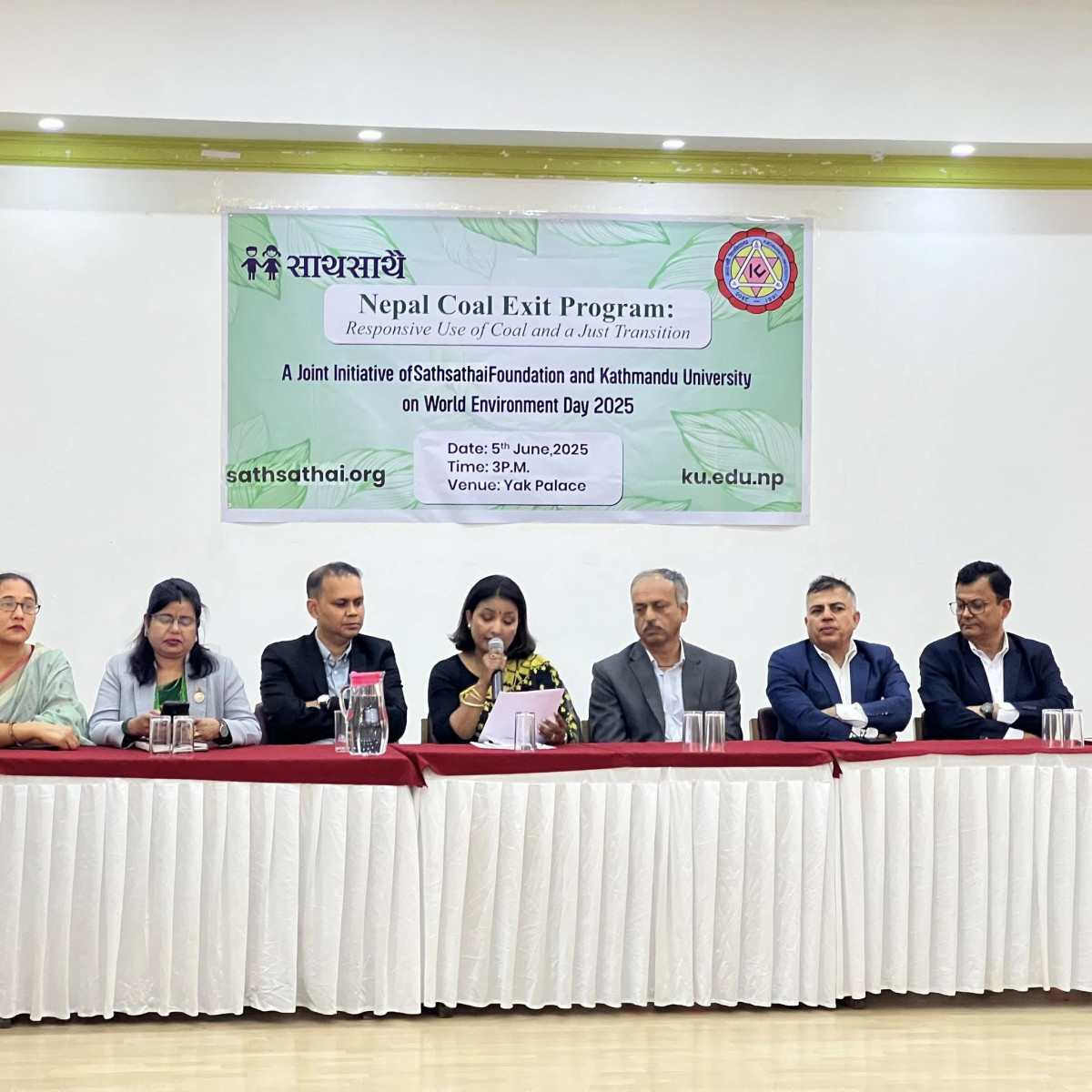
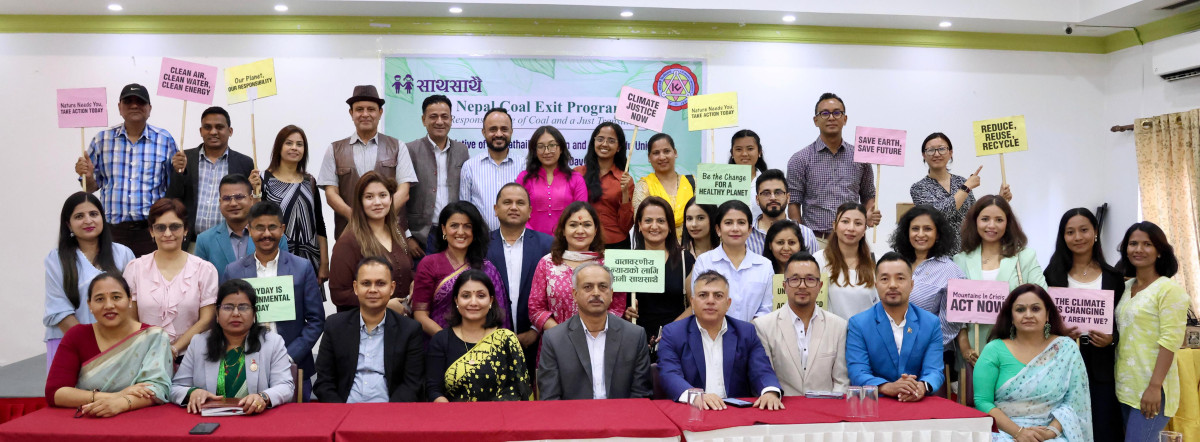
Patan (Lalitpur), 5 June 2025 - In a joint initiative by the SathSathai Foundation and Kathmandu University, the Nepal Coal Exit Program: Responsive Use of Coal and a Just Transition has been officially launched.
Marking World Environment Day 2025, the program envisions a coal-free Nepal by 2045 and aims to promote the responsible use of coal during the transition phase and ensure a just energy shift. The announcement was made by Dr. Biraj Singh Thapa, Assistant Professor at Kathmandu University and Head of the Green Hydro Lab. He stated that the university and SathSathai Foundation have come together to collaborate on addressing challenges posed by climate change.
“While human progress continues to reach new heights, climate change has posed serious threats to civilization. It is crucial that we unite to address this. Nepal has immense potential for hydropower, which can help replace fossil fuels and promote prosperity through clean energy,” Dr. Thapa emphasized.
Speaking at the event, Renu Devi Sah, a member of the Madhesi Commission, stressed the need to shift towards renewable energy as an alternative to coal.
Sushil Chandra Acharya, Joint Secretary at the Ministry of Energy, Water Resources, and Irrigation, remarked that although Nepal contributes minimally to global carbon emissions, it has been significantly affected by climate change. He highlighted the need to develop long-term strategies aligned with the national energy roadmap to address climate impacts, such as the rapid melting of the Himalayas.
Mitra Baral, Director General at the Department of Irrigation, noted that while reducing coal usage is possible, an immediate ban is impractical. Instead, he emphasized the importance of optimizing Nepal’s hydropower potential to reduce reliance on coal.
Nirmala Sharma, President of the Federation of Nepali Journalists, emphasized the need to raise awareness at the grassroots level to build public understanding of climate and energy issues.
Sneha Upreti, a member from the Nepalese Youth for Climate Action (NYCA), expressed her appreciation for the initiative and emphasized the importance of youth involvement in climate discourse. She remarked that the concept of responsive use of coal is a crucial and timely step, as coal consumption remains a major driver of climate injustice. Upreti cautioned that without tangible action to support vulnerable communities, national dialogues like Sagarmatha Sambaad and participation in international platforms such as the COP climate conferences risk becoming symbolic rather than impactful.
Prof. Dr. Bed Mani Dahal, Dean of the School of Science at Kathmandu University, remarked:“The work we are doing today is not just for ourselves, but also for our ancestors and every living being on this planet. Once we identify the root of a problem, it is our responsibility to take action.”
He emphasized that environmental conservation is a shared responsibility and described the joint initiative between SathSathai Foundation and Kathmandu University as a meaningful and positive beginning. He further expressed the university’s strong commitment to strengthening this collaboration in the days to come.
Badri Sigdel, Editor-in-Chief of SaathSaathai News and a board member of the IFJ, underscored the importance of national consciousness in protecting the Himalayas, stating that “we owe it to future generations.”
Prajeeta Karki, Chairperson of SathSathai Foundation, explained that the program is built on inclusive, scientific, and strategic foundations.
“The Nepal Coal Exit Program aims to end coal dependency through a clear roadmap that ensures a just and responsible transition,” she said.
The initiative is positioned as a major national effort to transform Nepal’s energy sector. Key targets of the program include:
• Drafting a Nepal Coal Exit Policy by 2028
• Phasing out all coal-based plants by 2030
• Achieving 100% renewable energy capacity by 2050
• Ensuring a just transition for workers and industries affected by the coal phase-out
• Mobilizing climate finance, innovative technology, and international partnerships
The program will be implemented in three phases (2025–2040) and promotes the concept of “responsive coal use”—defined as minimal, temporary, and strategic use only during the transition period where absolutely necessary.
“This is not just about energy transition; it’s a moral commitment to our future generations. If we act together now, a coal-free Nepal by 2045 is possible,” concluded Chairperson Prajeeta Karki.